


I am pleased to share with you a 60” video animation explaining our IntOGen project using easy to understand terms:
Read the rest of this entry »
I am pleased to share with you a 60” video animation explaining our IntOGen project using easy to understand terms:
During our last retreat we decided to open a twitter account. Some of us (@nlbigas, @chris_zen, @elbioc) are already using twitter, but we found useful to have one group account where we can tweet and retweet our blog posts and other things related to biomedical genomics field.
It was not easy to find a username, in the end @bbglab is our twitter account. It’s an acronym of Barcelona Biomedical Genomics Lab.

Last year blog statistics
Since we started our blog one year ago we have received 2200 unique visitors with a returning rate of 37%. We think that this is a good returning rate but we want to make it easy to follow us, this is why we are opening this twitter account and also giving the option to follow us through email. And of course you can still use RSS if you prefer.
p27, also called Kip1, is a well known protein with a crucial role in cell cycle progression and cancer. p27 best known function is the inhibition of cyclin-dependent kinase (cdk) activities, cyclin E-CDK2 and cyclin D-CDK4 complexes, and has a role in controlling the cell cycle progression at G1. However it was unclear if p27 may have other roles in the nucleus other than acting as a CDK inhibitor.
A paper published this week in Oncogene shows that p27 has also a role as a transcriptional repressor, which is independent of cyclin-cdk regulation. This work has been leaded by Oriol Bachs and Raffy Pippa from IDIBAPS, and we, Gunes and myself, and other researchers from IMIM, CIEMAT and University of Toulouse have participated in the project.

Model illustrating the participation of p27 on the organization of p130/E2F4 repressor complexes. p130 first drives E2F4 to the promoters, then p27 is subsequently loaded by directly interacting by its carboxyl-domain with both p130 and E2F4. Finally, p27 recruits the co-repressors HDAC1 and mSIN3A on these promoters.
This week our blog has turned one year old. We started the blog on 10th December 2010 with the idea of having a more flexible way of communicating with the research community, in addition to publications, seminars and conferences. We are happy with the experience and in our last retreat we decided to continue blogging, so more posts from our lab are to come during 2012.
Good news everyone!
Last friday night – just returning from our retreat – we all received an email from Núria announcing the great news that she is going to be awarded with the Catalan National Award for Young Research Talent (Premi Nacional de Recerca al Talent Jove).
The award acknowledges a young researcher which has shown excellency and quality in his/her professional work and brings a donation of 10.000€. This is very encouraging for the whole group to continue our work as we are doing it and keep contributing good work to the research community.
Recent important efforts include IntOGen, Gitools and Condel. For those interested in more details, they can take a look at Núria’s Curriculum Vitae and Google Scholar Profile.
Official announcement (in Catalan)
UPF news about the award (in Catalan)
GRIB news about the award (in Catalan)
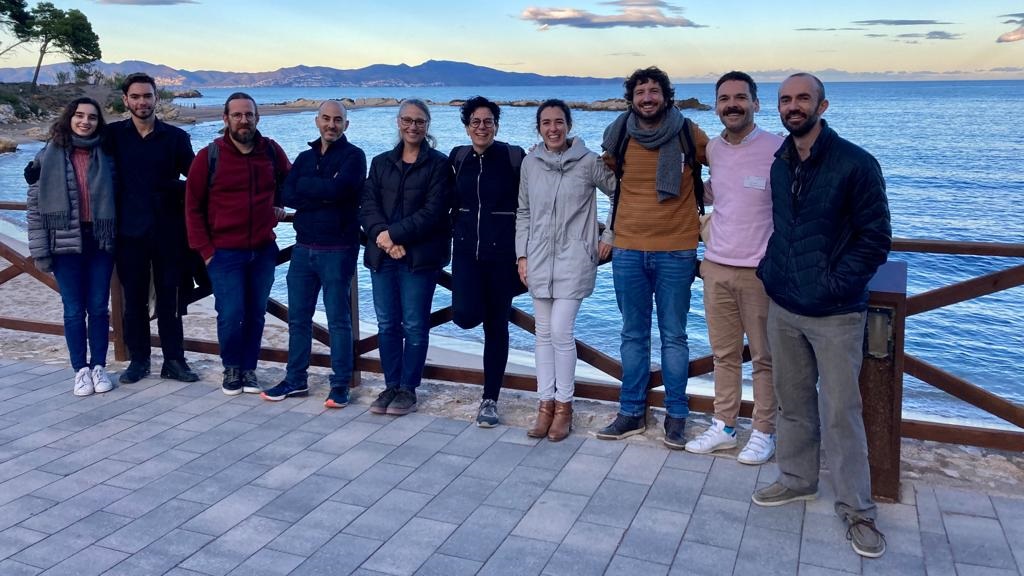
This last week we – the whole lab – spent a couple of days in a rural house near Ripoll, in the central area of Catalonia. We dedicated these two days to talk about the work we do and the projects we are developing in a more relaxed environment. We could experience again that the independence of our everyday working habits fosters our creativity. This made it possible that those were two very fruitful and interesting days.
We have published a new section in IntOGen in collaboration with Hautaniemi Lab, where you can do a gene correlation with the gene expression results of TCGA (The Cancer Genome Atlas) for a given subset of patients that share some specific clinical annotations. Then you will be able to browse your correlations next to global gene expression, SNP survival and DNA methylation analyses. The data analyzed so far includes 4 tumor types from TCGA: glioblastoma multiforme (GBM; 507 samples), ovarian serous adenocarcinoma (OV; 546 samples), breast invasive carcinoma (BRCA; 525 samples) and colon adenocarcinoma (COAD; 161 samples).
Few months ago, Xavi and Michi wrote a post titled SVGmap: Configurable image browser for experimental data, which described a new tool developed in our lab. SVGmap is useful to create browsers for individualized high-quality images which change the color of some regions according to some values. For example, let’s say that you have expression data for various cell types in a particular tissue (or for various tissues in Drosophila, as in the image), you can draw an SVG image of the tissue showing each of the cell types and provide a tabulated file with the expression data, after few steps you can have a browser that allows you to search for particular genes and display the SVG image with the colors corresponding to the expression of each gene for each cell type. You can see some examples in the SVGmap web.
We are pleased to announce that we will be giving another practical course on bioinformatics for Integrative Genomics this year. It will take place from November 7-9, 2011, in Oeiras, Portugal, as part of the Gulbenkian Training Programme in Bioinformatics. The course teachers will be Alba Jené and myself from our group. Read the rest of this entry »
We have very good news to share with you.
Gunes Gundem has done this morning the defense of her Thesis work. She did a 35 minutes presentation and then answered questions from the committee for about 1 hour and 15 minutes. She did very well both in the presentation and the questions and she was granted the PhD title with distinction.
We are all very proud of her!
After the defense we had a nice lunch at the terrace of the fifth floor with lots of delicious turkish food.